
Summary
People now get answers about your brand from AI assistants and AI search summaries, and the way those answers are built keeps changing. JPA Health explains what shifted, shares what happened when we claimed our own brand in ChatGPT, and shows how the Gretel Sentiment Sync tracker turns those changes into recommendations.
Ask ChatGPT about your brand today. Ask again in two weeks. The answer may not match.
That's the problem with brand visibility right now. It isn't a ranking you win once. It moves, and it moves in the places your audiences now go first.
How is AI changing the way people search for information?
For years, the goal of SEO was simple: secure a top position on Google's search results page. But today the most prominent position often belongs to an AI-generated summary, not a traditional website link. Pew Research Center found that people who encountered a Google AI summary clicked on a traditional search result in just 8% of visits, compared with 15% of visits when no AI summary appeared. Only 1% clicked a link within the AI summary itself. In other words, the answer itself has become the destination.
Healthcare is no exception. In its June 2026 survey of 3,488 U.S. adults, Pew found that 34% had used AI chatbots for at least one health reason, such as understanding lab results or figuring out what's causing symptoms. Among clinicians, we reported last year that 4 out of 5 HCPs say they use LLMs to support clinical decision-making.
Whether someone turns directly to an AI assistant or uses Google and encounters an AI-generated summary, they're increasingly forming impressions and making decisions before ever visiting your website. The challenge is no longer just getting found in search results. It's making sure your brand is visible, credible, and accurately represented in the AI-generated answers people rely on.
How do LLMs decide what to say about your brand?
The second shift is less visible, but just as important: AI platforms don't all draw on the same sources, and the way they generate answers is constantly evolving.
Google, for example, describes its AI search features as using retrieval-augmented generation (RAG), which grounds AI-generated answers in information from its search index. In AI Mode, Google also uses a process called query fan-out, running multiple related searches across different subtopics to gather information before generating a response. Rather than simply returning a ranked list of websites, it synthesizes information from multiple sources into a single answer.
And those sources can vary significantly by platform. In our own tracking, we've seen some AI models draw more heavily on patient advocacy organizations, while others favor published research. Pew Research Center also found that Wikipedia, YouTube and Reddit were among the most frequently cited sources in both Google's AI summaries and traditional search results.
The platforms themselves are evolving, too. On Nov. 10, 2026, OpenAI announced businesses in ChatGPT, a new way for brands to register how they appear.
A one-time snapshot of what AI says about you goes stale quickly. That makes ongoing measurement essential. But before we could recommend a monitoring approach to clients, we wanted to understand what happens when a brand actively manages its presence in an AI platform.
What happened when we claimed our own brand in ChatGPT?
We didn't want to recommend it without trying it first. JPA registered its business and URL in ChatGPT on Nov. 10, the day of the announcement. Since then, we've asked ChatGPT the same three questions about JPA Health every two days and scored each answer from 0 to 100 on how closely it reflects our own brand positioning.
Three things changed:
• Answers got longer. Before Nov. 10, a ChatGPT answer about JPA ran about 2,400 characters. Since Nov. 12, it averages about 9,300, or 3.9 times longer. The new answers read like full company profiles, with sections on services, markets, reputation and competitive position. More space means more of our story reaches the reader.
• The sources changed. Cited links carry a tag that shows where the answer came from. In the 8 earlier answers that carried one, it read utm_source=openai. In all 9 answers since Nov. 12, it reads utm_source=chatgpt.com. Each answer also cites more pages, from 3.4 on average to 8.6, and leads with jpa.com and our About page.
• The score moved. The average score was 62.8 on Nov. 10 and 86.4 on Nov. 12. It settled at 77.1 by Nov. 16.
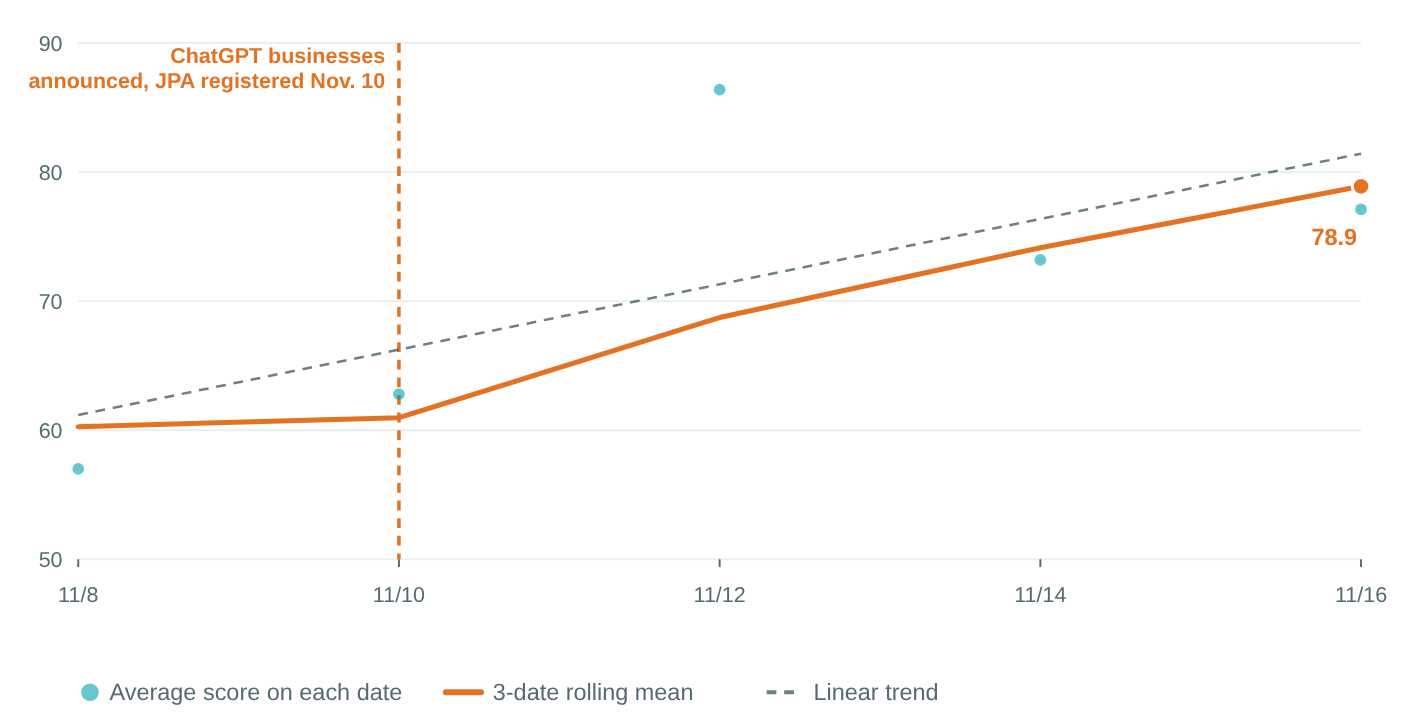
Average score on how closely ChatGPT's answers about JPA Health reflect JPA's own positioning, 0 to 100. ChatGPT only, Nov. 8 to Nov. 16, 2026. The rolling mean on Nov. 8 and Nov. 10 also uses earlier collection dates, which are not plotted.
A caution on how to read this. We made other changes to our content and presence during the same period, so we can't credit the registration alone, and nine answers is still an early sample. The direction is clear enough that we recommend clients claim their brand now. We'll keep measuring.
How do you track AI visibility over time?
Last year, we introduced JPA's Gretel Sentiment Sync, which compares how a brand wants to be seen with how LLMs, media, social and the web actually describe it, and recommends where to close the gaps. It gave clients one clear comparison.
The case above shows why one comparison isn't enough, so we now track it over time. The Gretel Sentiment Sync tracker sends the same standing prompts to five AI engines (ChatGPT, DeepSeek, Google AI Mode, Google AI Overviews and Perplexity) and scores every response against the client's own message framework. It shows:
• The overall score trend, and each engine's trend on its own
• A weekly heatmap of which engines are strong and which lag
• A change log of site updates, platform changes and communications activity, with scores before and after each one
• Which score components drove the movement
• How often responses identify your brand correctly rather than confusing it with a similarly named organization, and how often they're labeled positive
A dashboard only surfaces the insights, though. The value comes from what your team does next. We can use these insights to continually refine recommendations, identify content and earned media opportunities, and track changes in your brand's AI visibility and positioning.
That last part matters because earned coverage and credible third-party voices shape the sources the engines draw on. When a score drops, the tracker shows where and roughly when. Our AI & Research Solutions and public relations teams then decide whether the fix is a website change, a placement, a partnership or a piece of thought leadership.
Let's work together.
If you haven't claimed your brand in ChatGPT, start there. But don't stop at a single profile update or a one-time assessment.
As you build your 2027 communications plan, talk with your JPA team lead about adding Gretel Sentiment Sync and ongoing AI visibility tracking. You'll get a baseline understanding of how AI platforms describe your brand, see how that perception changes over time, and identify where strategic communications can make a difference.
Want to know what AI is telling people about your brand? Connect with JPA Health to discuss a baseline Sync and ongoing tracking.